Automation Playbooks
Ultimate Guide To Petty Cash Book Format And Operations
Petty cash format, operations, and significance, offering insights to streamline your financial processes.

Suppose your office needs a quick coffee refill or emergency postage stamps. You can’t go through the entire finance department for every minor expense, right? This is where the petty cash book steps in, keeping track of small but essential costs with ease and transparency.
This blog will guide you through petty cash format, operations, and significance, offering insights to streamline your financial processes.
Understanding the Petty Cash Book
A petty cash book is a subsidiary ledger that records small, recurring business expenses. It is a dedicated record for minor transactions that don’t require formal accounting entries, such as office supplies, travel expenses, or staff refreshments. The primary purpose of the petty cash book is to simplify bookkeeping by consolidating these minor expenses in one place, thereby ensuring the main cash book remains uncluttered.
The petty cashier manages the petty cash book, which enables accurate tracking and control over minor cash outflows. This system helps businesses maintain transparency and ensures that even the smallest expenses are accounted for.
A petty cash book simplifies the management of small, day-to-day expenses while offering flexibility to adapt to different business requirements. To understand its effectiveness, let’s explore the various formats commonly used to maintain petty cash books.
Formats of Petty Cash Book
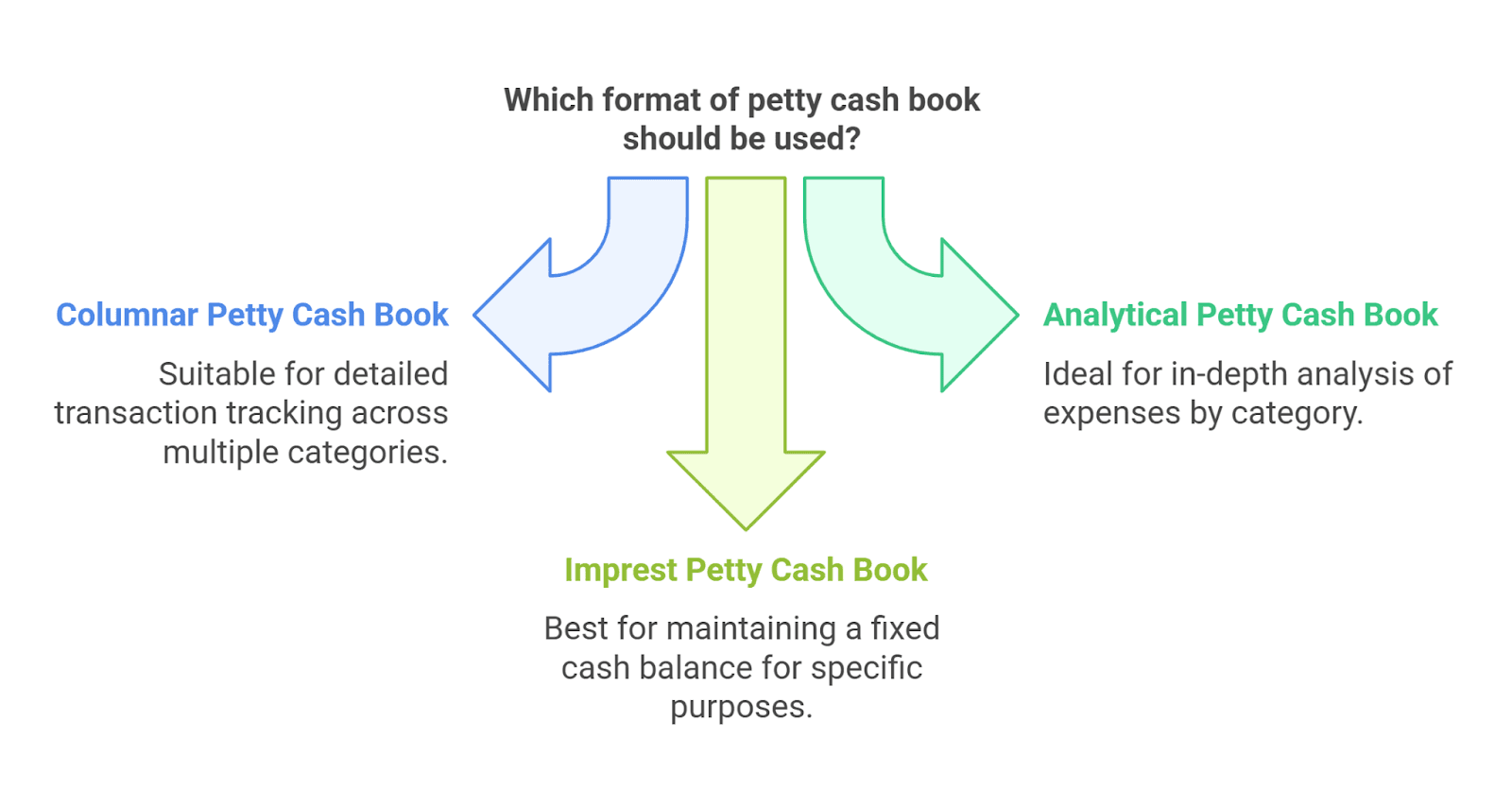
Understanding the formats of petty cash books is essential for customizing the system to your business’s specific needs. Each type fulfils a distinct purpose, addressing varying levels of detail and control. Below are the various formats designed to record petty cash transactions, providing in-depth insights to ensure effective expense management.
1. Columnar Petty Cash Book
This format features multiple columns, each dedicated to a specific type of expense, such as postage, stationery, or travel. It streamlines categorization and simplifies the process of summarizing expenditures.
2. Analytical Petty Cash Book
An Analytical Petty Cash Book is similar to the columnar format but provides more detail. It includes individual columns on the credit side for each petty expense, offering a clearer breakdown of fund allocation.
3. Imprest Petty Cash Book
The imprest petty cash book follows a fixed balance system, allocating a specific amount at the beginning of a period. Expenses incurred are replenished at the period’s end, ensuring effective auditing and maintaining financial discipline.
Simplify your bookkeeping process with Pazy’s petty cash management tools, designed to fit every business format.
Understanding the different types of petty cash books provides guidance for selecting the most suitable method to track and manage expenses. Let’s explore how these diverse approaches form the basis for effective petty cash operations.
Operations of Petty Cash Fund
The operations of a petty cash fund involve the management and disbursement of small amounts of money for incidental expenses within an organization. The fund is typically maintained by a designated custodian, who is responsible for ensuring its appropriate use and proper documentation. When an expense is incurred, the custodian provides the necessary funds and records the transaction. Receipts or vouchers are collected for all disbursements and retained for record-keeping purposes.
Periodic reconciliations are performed to verify the accuracy of the fund balance, and when necessary, the fund is replenished to ensure sufficient cash flow. The petty cash system enables organizations to handle minor expenses efficiently without the need for formal procurement processes.
Effective petty cash management, driven by well-defined processes, provides a structured approach for maintaining accuracy, ensuring compliance, and optimizing the use of funds. With this knowledge, let us learn how to post petty cash to the ledger.
Posting Petty Cash to Ledger
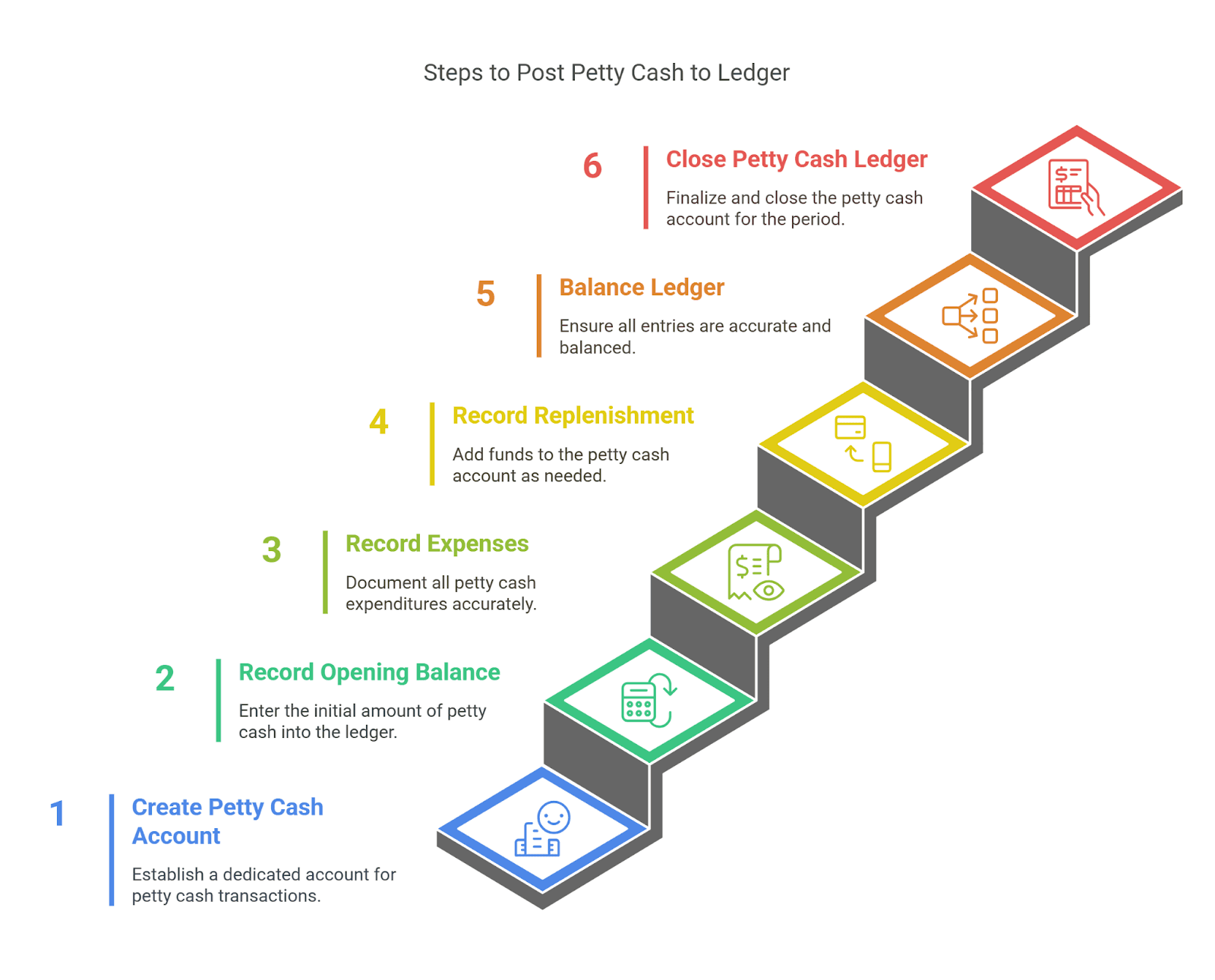
Posting petty cash to a ledger involves recording the small, day-to-day expenses made by a business. Here’s a step-by-step process to record petty cash transactions in the ledger:
1. Create a Petty Cash Account
To create a petty cash account, designate it as “Petty Cash” with a Current Asset account type. This account will specifically track the small, day-to-day expenses that arise in the business.
2. Recording the Opening Balance
Record the initial amount of petty cash at the start of the accounting period by debiting the Petty Cash account. This represents the cash balance at the beginning, with no corresponding credit entry at the outset.
Example:
Date: [Start Date of Period]
Description: Petty Cash Opening Balance
Debit: Petty Cash = ₹500
Credit: —
3. Recording Petty Cash Expenses
Record the transaction to reflect the cash outflow whenever you use petty cash for an expense. Debit the relevant account, such as office supplies, transportation, or meals, to indicate what was purchased or paid for. At the same time, credit the petty cash balance to show the reduction in available cash.
Example:
Date: [Date of Expense]
Description: Office Supplies
Debit: Office Supplies = ₹30
Credit: Petty Cash = ₹30
OR if the expense is a reimbursement:
Date: [Date of Expense]
Description: Reimbursement for XYZ Employee – Business Lunch
Debit: Reimbursement Expenses = ₹50
Credit: Petty Cash = ₹50
4. Recording Petty Cash Replenishment
When the petty cash fund runs low, it is replenished by adding more money from the bank or another cash source. The entry is recorded as a debit to the Petty Cash account, reflecting the amount added to restore the balance, and a credit to the Bank/Cash account, indicating the source of the replenishment.
Example:
Date: [Replenishment Date]
Description: Petty Cash Replenishment
Debit: Petty Cash = ₹200
Credit: Bank/Cash = ₹200
5. Balancing the Ledger
At the end of each accounting period, reconcile the petty cash account by comparing it with the actual physical cash. Ensure that the total expenses recorded match the cash on hand.
Example:
Date: [End of Period]
Description: Reconciliation – Petty Cash
Debit: Petty Cash – [Ending Balance]
Credit: —
6. Closing the Petty Cash Ledger
After reconciling all petty cash transactions, finalize the ledger by documenting the closing balance. This step ensures the account is ready for the subsequent accounting period.
Example:
Date: [Close Date]
Description: Petty Cash Closing Balance
Debit: Petty Cash – [Ending Balance]
Credit: —
Simplify your ledger posting with Pazy’s automated accounting features, making your financial management seamless and accurate with real-time insights into your financial activities.
Businesses can maintain organized and transparent financial records by following these steps to post petty cash transactions to the ledger. However, even with these procedures in place, managing petty cash effectively can still pose challenges. Let’s explore how automation can ensure a streamlined, efficient, and error-free process, addressing common pitfalls and enhancing overall financial management.
Read more: Effortless Expense Tracking: How to Use a Petty Cash Book the Right Way
Overcoming Petty Cash Challenges through Automation
Managing petty cash presents several challenges, including the lack of proper documentation, which leads to discrepancies and unauthorized transactions. Manual cash handling increases the risk of errors, theft, or fraud, making financial transparency difficult. Reconciling accounts can become complicated, especially when businesses fail to conduct regular audits. Delays in replenishing funds can disrupt operations, particularly when employees need immediate reimbursements.
Technology helps address these challenges by offering automated systems for approval processes, real-time tracking, and reconciliation, reducing errors and ensuring accurate cash handling. AI-driven tools categorize transactions and provide financial insights, aiding in effective budgeting. Mobile apps enable users to record expenses, capture receipts, and request reimbursements, enhancing the overall petty cash management process.
Technology has greatly improved the efficiency, accuracy, security, and accessibility of petty cash management. With the integration of digital tools such as Pazy, businesses can simplify cash-handling tasks, enhance control over minor expenses, and optimize their overall financial management.
Streamlining Petty Cash with Pazy’s Automation

Pazy is a digital tool designed to streamline petty cash management by automating the entire process. It helps businesses track cash flow, categorize expenses, and reconcile transactions in real time. With Pazy, users can easily manage petty cash, reduce manual errors, and ensure accuracy and transparency in financial records.
Integrated Financial Automation
Automating petty cash tracking with Pazy reduces manual entry and streamlines reconciliation in the petty cash book. It ensures real-time and accurate recording of expenses, improving overall financial oversight.
Real-Time Financial Visibility
Pazy provides up-to-date insights into petty cash balances and expenditures, giving clear visibility into the petty cash book and enabling businesses to make informed decisions for better cash flow management.
AI-Driven Precision and Compliance
AI-powered features in Pazy ensure precise expense tracking in the petty cash book while ensuring full compliance with accounting standards, including automatic GST calculations and accurate reporting.
Seamless Integration with Existing Systems
Pazy integrates smoothly with existing financial systems, eliminating the need for manual data transfers in the petty cash book and enhancing productivity in financial management and reporting.
Pazy simplifies petty cash management for small to medium-sized businesses and startups by streamlining processes, reducing errors, and enhancing oversight in the petty cash book. It offers customized solutions for industries like construction and hospitality, ensuring accurate and efficient recording. Entrepreneurs can rely on Pazy for scalable financial management without the complexity of traditional systems.
Conclusion
Understanding the format and operations of the petty cash book is essential for maintaining financial discipline and ensuring accountability within an organization. From its fundamental purpose to the details of its operations, the petty cash book plays a vital role in managing minor yet essential expenses.
By adopting tools like Pazy, organizations can automate and streamline petty cash management, reducing errors and saving time. Pazy enhances financial transparency with real-time tracking and reporting features. This ensures better control, accountability, and efficient expense management.
Enhance expense tracking with Pazy and simplify petty cash management, improving financial clarity for businesses of all sizes. Partner with us to streamline your financial processes.
FAQs
1. Is the Petty Cash Book audited?
Yes, petty cash is subject to internal audits to ensure accuracy, prevent misuse, and maintain financial integrity.
2. Can a Petty Cash Book record both cash inflows and outflows?
A Petty Cash Book records both cash inflows and outflows. While it primarily focuses on outflows, it also records inflows like replenishments to maintain accurate balances.
3. What is a Petty Cash Voucher?
A petty cash voucher is a document used to record individual petty cash transactions, serving as proof of expenditure.
4. How does the Petty Cash Book differ from the main Cash Book?
The Petty Cash Book records only minor expenses, while the main Cash Book handles all major cash and bank transactions.
5. Can a Petty Cash Book record both cash and non-cash transactions?
Typically, only cash transactions are recorded in the Petty Cash Book; non-cash transactions are handled separately in other financial records.
OTHER BLOGS